There’s a quiet frustration most virtual assistants don’t talk about.
You’ve learned the skills.
You’ve set up your profile.
You’re applying, pitching, showing up…
And yet, someone else gets the client.
Not once. Not twice. But repeatedly.
So the question naturally becomes:
What are they doing differently?
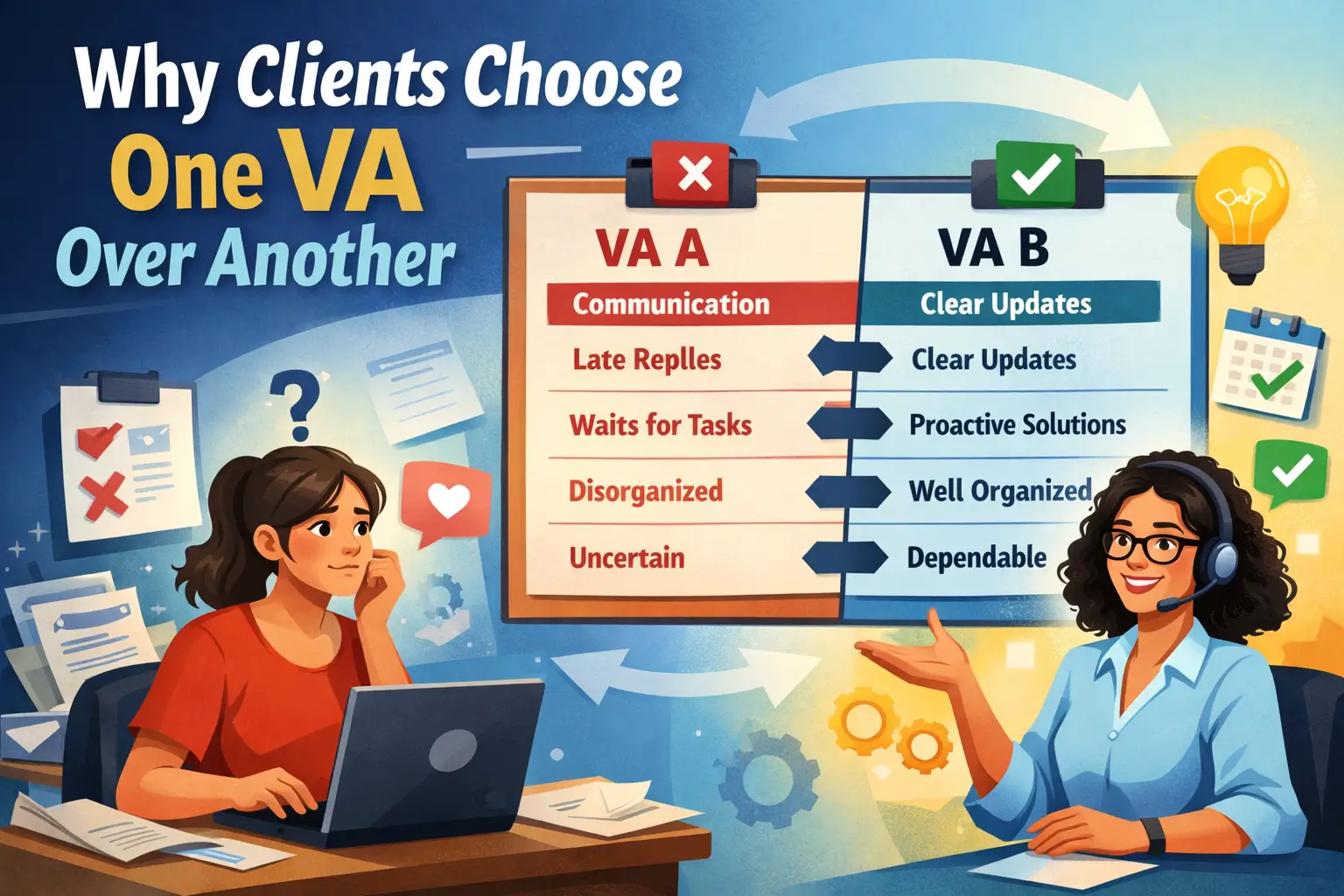
Because here’s the truth most people miss:
Clients are rarely choosing the most skilled VA.
They’re choosing the one who feels easiest to trust, easiest to communicate with, and easiest to work with.
In other words, they’re choosing the VA who reduces friction.
Let’s break down what that actually looks like.
The real decision drivers (what clients actually care about)

When clients compare VAs, they’re not just scanning for skills.
They’re asking themselves something far more human:
“Can I rely on this person?”
“Will this make my life easier or harder?”
“Do I feel comfortable handing things over to them?”
The VAs who consistently get chosen are the ones who answer those questions – without needing to say it outright.
Reliability and trust: the non-negotiable
This is the foundation of everything.
Clients are handing over access to their inbox, their calendar, their systems – sometimes even sensitive business information.
That’s not a small ask.
So naturally, they look for signals of trust:
- Do you follow through on what you say?
- Do you meet deadlines consistently?
- Do you take ownership when something goes wrong?
A VA who is dependable will almost always beat a VA who is slightly more skilled but inconsistent.
Because skill can be improved.
Trust is harder to rebuild.
Communication: the quiet differentiator
Most VAs think they communicate well.
Few actually do at the level clients need.
Strong communication isn’t just about replying quickly. It’s about removing uncertainty.
That means:
- Giving clear, structured updates
- Letting clients know what’s happening without being asked
- Asking questions instead of guessing
- Matching the client’s preferred style (formal, casual, detailed, brief)
Good communication makes a client feel in control.
Great communication makes them feel supported.
And when a client feels supported, they stop looking elsewhere.
Initiative: the trait that changes everything
This is where average VAs and standout VAs separate.
One waits for instructions.
The other thinks ahead.
Clients notice the difference immediately.
A proactive VA will:
- Spot inefficiencies and suggest improvements
- Anticipate needs before they’re voiced
- Solve small problems without escalating everything
This doesn’t just save time – it builds trust fast.
Because from the client’s perspective, they’re no longer managing a task.
They’re working with someone who gets it.
Organisation and time management: what keeps everything running
Behind every great VA is a system.
Clients might not always see it, but they feel it.
Work gets done on time.
Nothing slips through the cracks.
Projects move forward smoothly.
That’s what strong organisation looks like in practice.
It’s not about saying you’re “good at multitasking.”
It’s about showing that you:
- Can manage multiple priorities
- Keep track of deadlines
- Maintain consistency under pressure
When a client feels like things are under control, they relax.
And that’s a powerful advantage.
Personality and culture fit: the deciding factor
Here’s where things become less obvious – but just as important.
When two VAs have similar skills, clients choose based on feel.
- Who is easier to talk to?
- Who understands how I work?
- Who do I actually enjoy interacting with?
Because hiring a VA isn’t just a business decision.
It’s a relationship.
And people naturally choose the person who feels aligned with their energy, communication style, and values.
Skills vs traits: what actually wins the client

This is where many VAs focus on the wrong thing.
They keep adding more skills.
More tools.
More services.
But clients aren’t comparing based on who knows the most.
They’re comparing based on who feels like the better fit.
Skills are the baseline
At a certain level, most VAs look the same on paper.
They can:
- Manage inboxes
- Handle calendars
- Use common tools
- Complete admin tasks
They get you into the conversation, but they don’t win it.
Traits are what tip the decision
Once the baseline is met, everything shifts.
Now the client is choosing based on:
- Who communicates more clearly
- Who feels more reliable
- Who shows more initiative
- Who seems easier to work with
These are the factors that actually decide the outcome.
Why this matters
Because it changes how you approach everything.
Instead of asking:
“How can I learn more skills?”
You start asking:
“How can I make this easier for the client?”
“How can I build more trust?”
“How can I stand out in how I work, not just what I do?”
That’s where the real leverage is.
The power of self-sufficiency and adaptability

If there’s one thing clients don’t want, it’s to feel like they’ve hired another person to manage.
They’re already overwhelmed.
They’re already juggling too much.
So the VA who stands out is the one who reduces that load, not adds to it.
Why independence matters more than you think
In a remote working relationship, constant back-and-forth slows everything down.
Clients don’t want to explain every step.
They don’t want to check every detail.
They don’t want to chase updates.
They want to trust that things are handled.
A self-sufficient VA:
- Figures things out before asking
- Makes decisions within clear boundaries
- Moves tasks forward without waiting for permission
This creates a completely different experience for the client.
It feels smoother. Faster. Easier.
And that’s exactly what they’re paying for.
Problem-solving is a hidden superpower
Every business runs into small issues daily.
Missed emails. Scheduling conflicts. Broken links. Disorganised systems.
The average VA flags the problem.
The standout VA brings a solution.
Even something simple like:
“I noticed this issue – here’s how I suggest we fix it.”
…positions you differently.
Now you’re not just completing tasks.
You’re contributing to how the business runs.
Adaptability signals long-term value
Clients aren’t just hiring for today.
They’re thinking:
“Will this person grow with my business?”
That’s where adaptability comes in.
- Being open to new tools
- Learning new systems quickly
- Adjusting to different workflows
A VA who shows they can evolve feels like an investment, not a short-term fix.
And that makes choosing them easier.
How positioning influences who gets chosen

Here’s something most VAs underestimate:
Two people can offer the same service…
…and still get completely different results.
Why?
Because of how they position themselves.
Clarity and specificity win every time
Vague offers create hesitation.
Clear offers create confidence.
Compare this:
“I offer general virtual assistant services.”
vs
“I help busy founders manage their inbox, schedule meetings, and stay organised each week.”
The second is easier to understand.
Easier to trust.
And easier to say yes to.
Benefits > Tasks
Clients don’t buy tasks.
They buy outcomes.
They want:
- More time
- Less stress
- Smoother operations
The VA who connects their work to those outcomes will always have an edge.
It’s not just what you do.
It’s what it does for them.
Why price isn’t the deciding factor
It’s easy to assume clients choose the cheapest option.
But in reality, many avoid it.
Because cheap often feels risky.
Clients are far more likely to choose:
- The VA who communicates clearly
- The VA who feels reliable
- The VA who makes things simple
Over the one who is just… cheaper.
Value builds trust.
Clarity reinforces it.
How clients actually compare VAs

When it comes down to a decision, clients often choose between two or three similar candidates.
And the differences are rarely dramatic.
They’re subtle, but powerful.
What that comparison looks like
| Factor | VA A (Generic) | VA B (Stand-Out) |
| Communication | Replies eventually, short answers | Sets expectations, gives clear updates, asks questions |
| Initiative | Waits for tasks | Suggests improvements and anticipates needs |
| Organisation | Says they’re organised | Explains systems and how work is managed |
| Trust & fit | Vague about process | Clear on boundaries, confidentiality, and workflow |
The key insight
The standout VA doesn’t necessarily do more.
They make the experience feel better.
Clearer. Safer. More structured.
And that’s what tips the decision.
Collaboration style and long-term value

Clients aren’t just hiring to solve a short-term problem.
They’re thinking long-term, even if they don’t say it out loud.
They want a partner, not just help
The most valuable VAs aren’t task-takers.
They:
- Understand the business over time
- Improve systems gradually
- Become a consistent, reliable presence
That kind of relationship is hard to replace, which makes it incredibly valuable.
Consistency builds trust over time
Anyone can show up once.
What clients really notice is:
- Do you deliver consistently?
- Does your quality stay high?
- Can you handle multiple priorities without dropping standards?
Consistency turns a “good hire” into a long-term one.
Boundaries signal professionalism
This might seem counterintuitive, but strong boundaries actually make you more attractive to clients.
Why?
Because they show:
- You manage your time well
- You respect your workload
- You operate professionally
Clients trust VAs who clearly define how they work.
It removes confusion and protects both sides.
Emotional safety: the hidden factor
This is rarely talked about but hugely important.
Clients choose VAs they feel comfortable with.
That means:
- They can ask questions without friction
- They feel understood
- They don’t feel judged or misunderstood
When a client feels “got,” the working relationship becomes stronger, and longer-lasting.
Bringing it all together: what makes a VA stand out

When you zoom out, the pattern is clear.
Clients consistently choose VAs who:
- Communicate clearly and proactively
- Show reliability and follow-through
- Take initiative and think ahead
- Stay organised and in control of their work
- Position themselves clearly
- Feel aligned and easy to work with
It’s not one big thing.
It’s a combination of small, consistent signals.
Conclusion: the real reason one VA gets chosen

It’s not about who knows the most.
It’s about who feels like the safest, easiest, and smartest choice.
The VA who wins is the one who:
- Reduces friction
- Builds trust quickly
- Makes the client’s life noticeably easier
So if you want to stand out, shift your focus.
Stop asking:
“What else do I need to learn?”
Start asking:
“How can I make this easier for the client?”
Because that’s the real difference.
And it’s what gets you chosen – every time.
Ready to hire a Virtual Assistant?
If you’re exploring virtual assistant agencies or need guidance on which model fits your business best – now is the time to take the next step.
Let’s find the right support for your workflow, growth, and peace of mind.
The right VA doesn’t just lighten your workload – they protect your momentum.
Why start from scratch when the right team is already trained and ready to plug into your workflow?
Get Started in 3 Easy Steps:
- Book a quick discovery call
- Tell us what your business needs
- Get matched with a trained VA – in days, not weeks
Let’s Build Your Support System
📩 Click here to schedule your consultation
📞 Prefer to talk? Contact us directly at 020 4586 6800
👉 Your next VA shouldn’t just save time – they should unlock growth.
Let’s make that happen. 🚀
FAQ: Why clients chose one VA over another
1. Do clients really care more about traits than skills?
Yes – once you meet the basic skill level.
Most clients expect you to know how to manage emails, calendars, and common tools. That’s the entry requirement. But when choosing between similar candidates, they prioritise reliability, communication, and ease of working together.
Skills get you considered.
Traits get you chosen.
2. What is the biggest mistake VAs make when trying to stand out?
Trying to compete on skills alone.
Many VAs focus on learning more tools or adding more services, thinking it will give them an edge. In reality, this often makes their offer more vague.
Clarity, communication, and positioning will differentiate you far faster than adding another skill.
3. How can I show reliability before I have client experience?
You show it through how you present yourself.
- Respond promptly and clearly
- Follow through on small commitments (like sending information when you say you will)
- Be organised in your communication
- Set clear expectations
Clients look for signals – not just past experience.
4. What does “being proactive” actually look like as a VA?
It’s about thinking one step ahead.
Instead of waiting for instructions, you:
- Ask smart, clarifying questions
- Suggest improvements
- Flag potential issues early
- Offer solutions, not just problems
Even small actions like these can make a big difference in how clients perceive you.
5. If two VAs have similar skills, what usually decides the final choice?
The overall experience of working with them.
Clients choose the VA who:
- Communicates more clearly
- Feels more organised and in control
- Shows more initiative
- Feels like a better personality fit
In most cases, it comes down to who feels easier to trust and work with – not who has the longer list of skills.