If you’re constantly pitching, chasing replies, and competing on price, it’s usually not a lead-generation problem.
It’s a positioning problem.
When you describe yourself as “a virtual assistant who offers admin, social media and inbox support,” you blend into thousands of others saying the same thing. Potential clients don’t see a specialist. They see a commodity.
Positioning changes that.

When you position yourself as the go-to problem-solver for a specific type of client, you stop convincing people to hire you. Instead, the right clients recognise themselves in your messaging and come to you already interested.
This article will show you how to:
- Choose a clear niche and USP
- Align your website and profiles with that positioning
- Use visibility and content to attract inbound enquiries
Let’s start with the foundation.
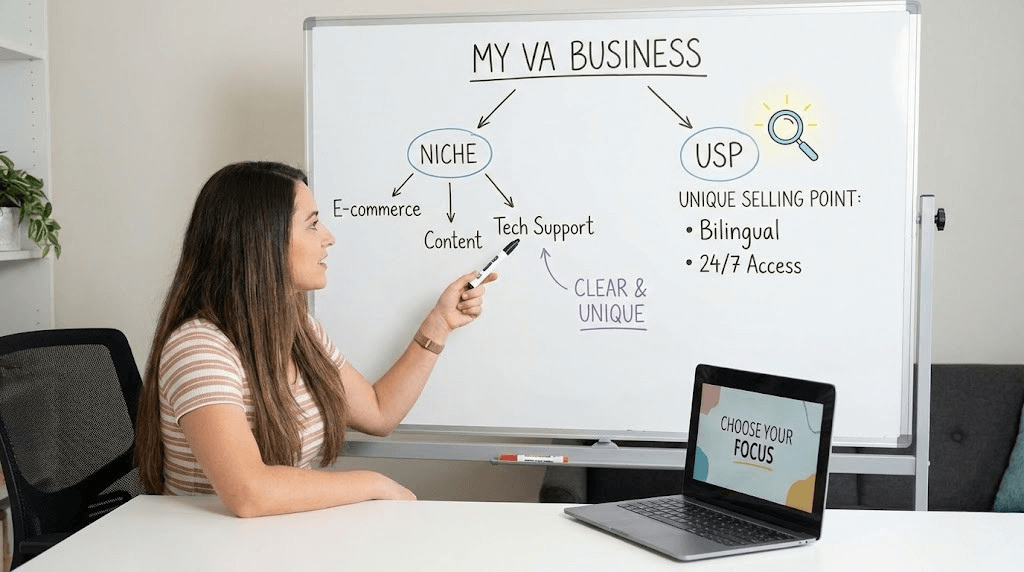
1. Choose a clear VA niche and unique selling point (USP)
1.1 Why “Virtual Assistant” is too broad
“Virtual assistant” describes how you work, not who you help or what problem you solve.
It’s like saying “consultant” or “freelancer.” It doesn’t tell clients:
- Whether you understand their industry
- Whether you’ve handled their specific challenges
- Whether you can step in without hand-holding
When you stay broad, you compete on availability and price.
When you niche down, you compete on expertise and relevance.
Specificity builds authority.
For example:
- “Online business manager for coaches launching group programmes.”
- “Podcast production VA for B2B founders.”
- “Executive VA for scaling tech founders.”
- “Property management VA for landlords with 10+ units.”
Now you’re not just a VA. You’re the obvious fit for a particular type of business.
1.2 How to choose your niche
There are two powerful ways to niche:
Industry-based niche
You specialise in supporting a particular sector, such as:
- Coaches and consultants
- Tech founders
- Property managers
- Creative agencies
- Course creators
This works well if you already understand that industry’s tools, terminology, and pace.
Service-based niche
You specialise in a specific function, such as:
- Podcast production
- Launch support
- Online business management
- CRM and systems setup
- Executive support
This works well if you have strong technical skills in a defined area.
The strongest positioning: combine both
The most powerful positioning often combines industry + service:
- “Launch support VA for online course creators.”
- “OBM for scaling coaches.”
- “Executive VA for SaaS founders.”
This makes your marketing sharper and your messaging clearer.
Instead of trying to appeal to everyone, you become the clear solution for someone specific.
1.3 Define your unique selling point (USP)
Once your niche is defined, your USP answers:
Why you over another VA in the same niche?
Your USP might be:
- Previous experience in that industry
- Deep knowledge of specific tools (ClickUp, Kajabi, HubSpot, etc.)
- A particular working style (proactive, strategic, detail-obsessed)
- Timezone or bilingual advantage
- Systems-focused approach rather than task-based support
Your USP should make clients think:
“This person understands exactly what I need.”
1.4 Craft a clear positioning statement
Now distil everything into one simple, clear line.
A helpful formula:
I help [specific type of client] achieve [specific outcome] by handling [key services].
For example:
- “I help solo consultants stay out of their inbox and in front of clients by managing email, calendar and proposals.”
- “I help online course creators run smooth, stress-free launches by managing tech, timelines and team coordination.”
This positioning line should appear:
- At the top of your website
- In your LinkedIn headline
- In your Instagram bio
- In directory listings
Clarity attracts. Vagueness repels.

2. Make your brand and online presence match that positioning
Choosing a niche is only the first step.
Now your online presence must reinforce it everywhere.
2.1 Align your website with your niche
When someone lands on your website, they should know within five seconds:
- Who you help
- What you handle
- What result they can expect
Your positioning statement and outcomes should sit clearly above the fold.
Instead of:
“Welcome to my VA services.”
Try:
“Free up 10+ hours a week in your consultancy by outsourcing admin, client onboarding and invoicing.”
Focus on outcomes, not tasks.
Clients care about saved time, smoother systems, fewer missed leads and less mental load – not that you can “manage emails.”
2.2 Use SEO to attract the right clients
If you want clients to come to you, your website needs to show up when they search.
That means optimising for phrases your niche would realistically type into Google, such as:
- “virtual assistant for coaches”
- “podcast production VA”
- “executive assistant for founders”
Use those phrases naturally in:
- Page headings
- Service descriptions
- Blog titles
- Meta descriptions
When your content matches what your niche is searching for, discovery becomes easier and more consistent.
2.3 Create consistency across all platforms
Your positioning should not change depending on where someone finds you.
Your LinkedIn headline, Instagram bio, website homepage and directory listings should all:
- Name the same niche
- Highlight the same core services
- Emphasise the same outcomes
Repetition builds recognition.
Recognition builds trust.
And trust is what makes someone move from browsing to enquiring.
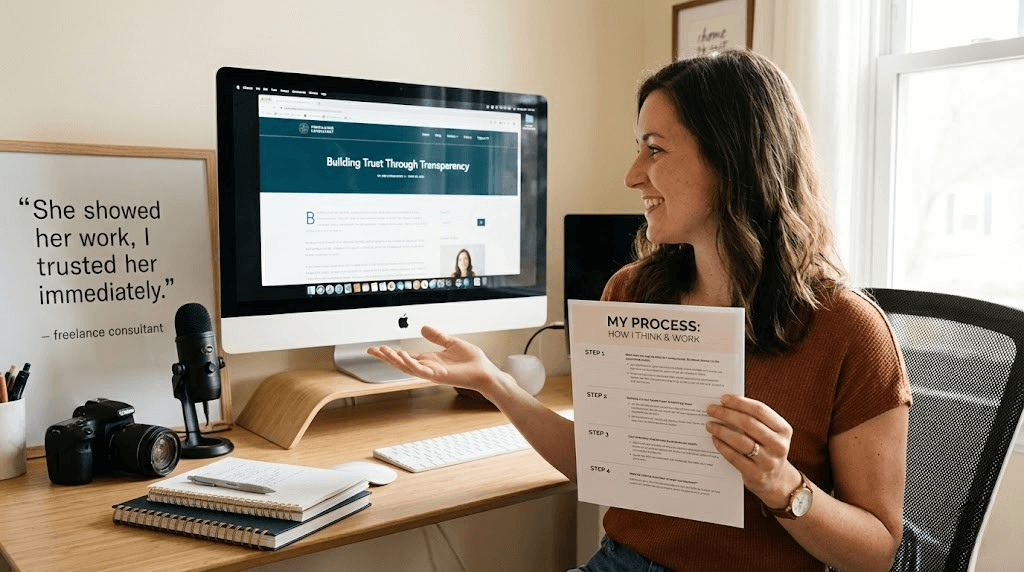
3. Use content to show how you think and work (so clients trust you before they enquire)
Once your niche and messaging are clear, content becomes your silent salesperson.
Instead of telling people you’re organised, strategic or proactive – you demonstrate it.
When done well, your content allows potential clients to:
- See how you approach problems
- Understand your process
- Trust your competence before ever speaking to you
That’s when enquiries shift from “What do you charge?” to “Are you available?”
3.1 Why content builds trust before enquiries
For service-based businesses like VAs, trust is everything.
Clients are handing over access to:
- Their inbox
- Their calendar
- Their clients
- Their systems
- Their revenue processes
They need to feel safe.
Content builds that safety by showing:
- Your thinking
- Your standards
- Your attention to detail
- Your understanding of their world
When someone reads three of your posts and thinks, “That’s exactly my problem,” you’re no longer a stranger. You’re a specialist.
3.2 Create practical, problem-solving content
The most effective content for a VA is practical and specific.
Focus on the real, everyday headaches your niche experiences:
- Inbox overload
- CRM chaos
- Missed follow-ups
- Launch timeline confusion
- Podcast workflow bottlenecks
- Client onboarding delays
Create:
- Short how-to guides
- Checklists
- “Before and after” workflow breakdowns
- Process explanations
- Mistakes you see businesses making
This positions you as someone who understands operations, not just tasks.
3.3 Turn your blog and LinkedIn into your shop window
Think of your blog and LinkedIn profile as your public portfolio.
They should consistently reinforce:
- Who you help
- What you handle
- The problems you solve
You don’t need to be everywhere.
One or two platforms done deeply is far more powerful than five done inconsistently.
For many B2B VAs, LinkedIn works particularly well because founders, consultants and business owners already spend time there. Your blog then becomes a long-form authority hub that supports it.
The goal is simple:
When someone clicks through to your profile, your expertise should feel obvious.
3.4 Always include a soft call-to-action
Content builds trust. But you still need to guide people to the next step.
Every piece of content should gently answer:
“If this resonates, what should they do next?”
That might be:
- “If you’d like help streamlining this, here’s how we can work together.”
- “Message me if this is something you’d rather delegate.”
- “You can book a clarity call here.”
No hard sell. Just clarity.
The easier you make it to enquire, the more likely people are to do so.

4. Show up where your ideal clients already are
Positioning isn’t just about messaging.
It’s about proximity.
You want to be visible in the rooms your ideal clients already spend time in – not just in spaces full of other VAs.
4.1 Stop networking in generic VA spaces
VA communities are valuable for support and collaboration.
But they rarely generate clients.
If you want inbound enquiries, you need to be present where business owners gather – not where service providers gather.
4.2 Identify niche-specific communities
Look for:
- Industry-specific Facebook or LinkedIn groups
- Slack communities for founders or consultants
- Sector networking events
- Local business meetups
- Online conferences or webinars
For example, if you support coaches, join communities for coaches – not assistants.
When you consistently show up in those spaces, you stop being invisible.
4.3 Become known for helpful answers
Don’t pitch.
Answer questions thoroughly.
If someone asks about:
- Organising client onboarding
- Managing inbox overwhelm
- Streamlining launches
Respond with practical, thoughtful advice.
People will click through to your profile out of curiosity.
And if your positioning is clear, those profile views turn into enquiries.
4.4 Focus on depth over breadth
You don’t need:
- TikTok
- Threads
Choose one or two platforms where your ideal clients are active and show up consistently there.
Depth builds recognition.
Recognition builds trust.
Trust builds inbound enquiries.
5. Turn existing work and relationships into a client magnet
Many VAs overlook the most powerful positioning asset they already have: proof.
Social proof accelerates trust faster than any marketing strategy.
5.1 Start with people who already trust you
Your first inbound clients often come from:
- Former employers
- Previous colleagues
- Professional contacts
- People who already know your work ethic
Let your network know what you now specialise in.
5.2 Build case studies from real results
Even small projects can become powerful positioning tools.
Show:
- What the situation looked like before
- What you implemented
- What changed as a result
For example:
- Reduced inbox backlog from 1,200 emails to zero
- Cut onboarding time from two weeks to three days
- Streamlined a launch timeline that saved 15 hours per week
Specific outcomes make your expertise tangible.
5.3 Use testimonials strategically
Ask for testimonials that highlight results, not just personality.
Instead of:
“She’s lovely to work with.”
Aim for:
“Since working with her, I’ve saved 8–10 hours a week and haven’t missed a single client inquiry.”
Place testimonials:
- On your homepage
- On service pages
- On LinkedIn
- In proposals
They reinforce your positioning without you having to say a word.
6. Bringing it all together: the inbound positioning formula
When clients come to you consistently, it’s rarely luck.
It’s usually this combination:
- A clear niche
- A strong USP
- Aligned messaging across platforms
- Visible expertise through content
- Strategic presence in the right spaces
- Proof of results
Positioning is not about being louder.
It’s about being clearer.
Conclusion
If you feel like you’re constantly chasing work, don’t immediately change your marketing tactics.
Change your positioning.
When you become the obvious solution for a specific type of client:
- You attract better-fit enquiries
- You reduce price sensitivity
- You spend less time convincing
- You build authority faster
Clients don’t come to the loudest VA.
They come to the clearest one.
And clarity is a choice you can start implementing today.
Ready to hire a Virtual Assistant?
If you’re exploring virtual assistant agencies or need guidance on which model fits your business best – now is the time to take the next step.
Let’s find the right support for your workflow, growth, and peace of mind.
The right VA doesn’t just lighten your workload – they protect your momentum.
Why start from scratch when the right team is already trained and ready to plug into your workflow?
Get Started in 3 Easy Steps:
- Book a quick discovery call
- Tell us what your business needs
- Get matched with a trained VA – in days, not weeks
Let’s Build Your Support System
📩 Click here to schedule your consultation
📞 Prefer to talk? Contact us directly at 020 4586 6800
👉 Your next VA shouldn’t just save time – they should unlock growth.
Let’s make that happen. 🚀
FAQ: How to position yourself so clients come to you
1. How do I position myself as a virtual assistant so clients come to me?
Start by narrowing your focus. Choose a specific niche (industry or service-based), define a clear USP, and ensure your website, LinkedIn, and content consistently reflect that positioning. When your messaging clearly states who you help and what outcome you deliver, ideal clients can quickly identify themselves as a fit – which increases inbound enquiries.
2. Do I need to niche down to attract better VA clients?
In most cases, yes. A general “virtual assistant” label makes you interchangeable with thousands of others. Niching down (for example, becoming a podcast production VA or an OBM for coaches) makes you more memorable, easier to refer, and more valuable. Specificity builds authority and trust faster than broad service lists.
3. What kind of content attracts virtual assistant clients?
Practical, problem-solving content works best. Share tutorials, workflow breakdowns, checklists, and “before and after” improvements that address your niche’s daily challenges. When potential clients see how you think and organise processes, they feel more confident reaching out.
4. How long does it take for positioning to start bringing inbound leads?
Positioning is a long-term strategy rather than an instant fix. When you consistently show up with clear messaging, aligned branding, and visible expertise, momentum builds over time. Many VAs begin seeing stronger, more qualified enquiries within a few months of focused positioning and visibility.
5. What’s the biggest mistake VAs make when trying to attract clients?
The most common mistake is trying to appeal to everyone. Broad messaging, inconsistent branding, and offering too many unrelated services dilute your authority. Clear positioning, knowing exactly who you help and how, makes it easier for clients to recognise you as the right choice and reach out proactively.