Choosing how to learn is one of the first serious decisions you’ll make as an aspiring virtual assistant.
Do you go the independent route – learning through self-paced modules and free resources?
Or do you invest in a mentored program with structured guidance and accountability?
Both options can work. Research across multiple industries shows that self-directed learners can achieve similar skill gains to structured learners, if they are disciplined enough. But learning style, career goals, and personal habits play a major role in determining which path actually leads to results.
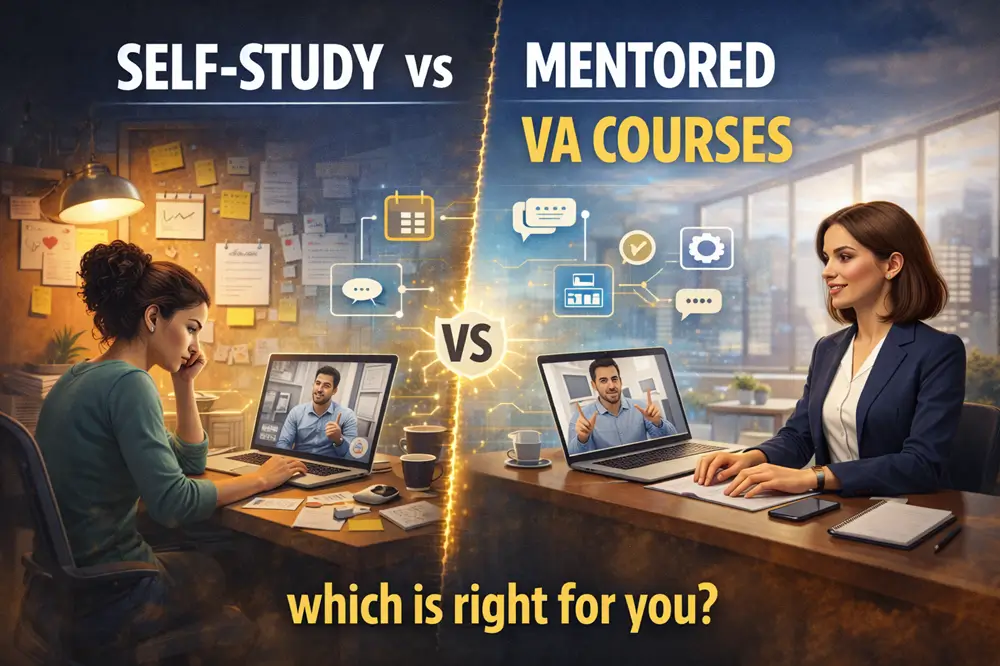
If your goal is simply to “learn about” virtual assistance, either option may suffice.
But if your goal is to become client-ready, confident, and operationally competent as quickly as possible, the difference between self-study and mentored learning becomes much more significant.
Let’s break it down.
What are self-study VA courses?

Self-study VA courses are designed for independent learners. They typically include:
- Pre-recorded video lessons
- Downloadable guides and templates
- Worksheets and exercises
- Access to community forums or groups
- Modules on core skills like admin tasks, social media management, and client pitching
The biggest advantage? Flexibility.
You control your schedule. You can move at your own pace. You can revisit lessons as often as you like. Many self-study resources are low-cost or even free, making them highly accessible.
For disciplined learners, this can be extremely effective.
In fact, research in related fields shows that self-directed learners can achieve comparable skill improvements to mentored learners when they are consistent and motivated. If you are naturally proactive, structured, and capable of identifying and correcting your own weaknesses, self-study may serve you well.
However, the strengths of self-study are also where the risks lie.
Without deadlines or accountability, procrastination becomes easier. Without personalised feedback, mistakes can go unnoticed. Without mentorship, you may not even realise where your knowledge gaps exist.
Isolation is another common challenge. While forums and groups exist, they do not replace real-time correction, structured progression, or experienced guidance tailored to your specific goals.
Self-study works, but it requires strong internal discipline and clarity from day one.
What are mentored VA courses?

Mentored VA courses combine structured curriculum with direct guidance.
Instead of simply consuming content, you receive:
- Tutor or mentor feedback
- Live Q&A sessions
- Structured learning pathways
- Accountability check-ins
- Networking opportunities
- Real-world insights from experienced professionals
This structure is particularly powerful for beginners.
Virtual assistance isn’t just about learning tasks. It’s about understanding tools (such as Google Workspace and Canva), setting up systems, identifying niches, pricing services, and positioning yourself professionally. A mentor shortens the trial-and-error phase dramatically.
Studies show that 75% of professionals say mentorship positively impacts career growth. The reason is simple: feedback accelerates development.
When someone experienced reviews your work, corrects mistakes early, and helps you refine your positioning, you avoid building on weak foundations.
Mentorship also addresses one of the biggest silent barriers for new VAs: confidence.
It’s one thing to complete a module on client onboarding.
It’s another to know you’re doing it correctly.
Mentored programs provide clarity. They provide correction. They provide momentum.
Yes, they require a higher financial investment.
Yes, they may involve scheduled sessions.
But in return, you gain structure, accountability, and faster progression toward being client-ready.
For those entering the industry without prior experience, or those who struggle with consistency, mentored learning often reduces overwhelm and increases follow-through.
And in a service-based career, execution matters more than information.
Self-study vs mentored VA courses: a side-by-side comparison

Now that we’ve outlined both approaches, let’s compare them across the areas that matter most when building a sustainable VA career.
1. Cost
Self-study:
Typically low-cost. Many resources are free or budget-friendly. This makes self-study accessible to almost anyone.
Mentored:
Higher upfront investment due to tutor access, live sessions, and structured support.
At first glance, self-study appears more economical. However, cost should be measured not just in money, but in time, missed opportunities, and trial-and-error mistakes.
2. Flexibility
Self-study:
Fully self-paced. You choose when and how you learn.
Mentored:
More structured. Often includes scheduled sessions, deadlines, or live components.
Flexibility can be a strength, but it can also delay progress if structure is missing. For many new VAs, external structure creates momentum that self-pacing does not.
3. Accountability
Self-study:
Entirely dependent on self-motivation.
Mentored:
Built-in accountability through feedback, check-ins, and deadlines.
This is one of the biggest differentiators. Many learners don’t struggle with intelligence, they struggle with consistency. Mentorship bridges that gap.
4. Skill depth and application
Self-study:
You learn concepts but application depends on your interpretation. Mistakes may go uncorrected.
Mentored:
Personalised feedback corrects gaps early. You refine not just knowledge, but execution.
Becoming a successful VA is not about knowing what to do in theory. It’s about applying it correctly in real client scenarios. Guided correction dramatically reduces the risk of developing weak systems or underpricing your services.
5. Best fit learner profile
Self-study may suit you if:
- You already have business or admin experience.
- You are highly disciplined and proactive.
- You consistently follow through without external pressure.
- You can identify and fix your own weaknesses.
Mentored courses may suit you if:
- You’re new to the VA industry.
- You want to become client-ready quickly.
- You struggle with procrastination or overwhelm.
- You want structured guidance and clear direction.
- You value networking and professional feedback.
For most beginners, mentored learning reduces confusion and accelerates clarity.
The real question: what kind of support do you need?

This decision is less about which method is “better” and more about which environment helps you execute.
Self-study gives you information.
Mentorship gives you direction.
If you’ve ever purchased a course and not completed it, that’s a signal. If you tend to second-guess your work or hesitate to pitch clients, that’s another signal. If you want reassurance that you’re building your VA business correctly from the start, structure matters.
The faster you move from learning to earning, the more valuable guided support becomes.
What about a hybrid approach?

Some learners benefit from combining both methods.
You might:
- Start with foundational self-study modules.
- Invest in mentoring sessions for feedback and refinement.
- Use free guides for theory and paid guidance for execution.
This approach can work well, especially for those who want to manage costs while still gaining accountability.
However, many beginners find that starting with structured mentorship first creates a stronger foundation. Once you understand the standards and expectations of the industry, self-study becomes more effective because you know what “good” looks like.
Final verdict: which is right for you?

Self-study can absolutely work – if you are disciplined, experienced, and capable of directing your own growth without guidance.
But if you are serious about building a sustainable VA business, shortening your learning curve, and becoming confidently client-ready, mentored courses often provide a clearer, faster path.
The investment is higher.
The structure is firmer.
But the clarity, accountability, and confidence gained often outweigh the flexibility of going alone.
Information is accessible everywhere.
Guided transformation is not.
If your goal is not just to learn, but to launch, mentorship may be the strategic move.
Ready to hire a Virtual Assistant?

If you’re exploring virtual assistant agencies or need guidance on which model fits your business best – now is the time to take the next step.
Let’s find the right support for your workflow, growth, and peace of mind.
The right VA doesn’t just lighten your workload – they protect your momentum.
Why start from scratch when the right team is already trained and ready to plug into your workflow?
Get Started in 3 Easy Steps:
- Book a quick discovery call
- Tell us what your business needs
- Get matched with a trained VA – in days, not weeks
Let’s Build Your Support System
📩 Click here to schedule your consultation
📞 Prefer to talk? Contact us directly at 020 4586 6800
👉 Your next VA shouldn’t just save time – they should unlock growth.
Let’s make that happen. 🚀
FAQ: Self-study vs mentored VA courses: which is right for you?
1. Is a mentored VA course worth the extra cost?
It depends on your goals and learning style, but for many beginners, yes.
While self-study courses are more affordable upfront, mentored programs often reduce costly mistakes, shorten your learning curve, and help you become client-ready faster. The real value isn’t just in the lessons: it’s in feedback, accountability, and structured guidance.
If time, clarity, and confidence matter to you, the investment can pay for itself more quickly than a self-directed path.
2. Can I succeed as a VA with only self-study?
Yes: if you are highly disciplined, proactive, and capable of identifying and correcting your own gaps.
Research in related fields shows that motivated self-learners can achieve results comparable to structured learners. However, success with self-study requires consistency, strong execution habits, and the ability to apply knowledge without personalized feedback.
For many beginners, that level of independence takes time to develop.
3. How do I know if I need mentorship?
You may benefit from mentorship if:
- You’re new to the virtual assistant industry.
- You struggle with procrastination or finishing courses.
- You feel overwhelmed by where to start.
- You want reassurance that you’re setting up your business correctly.
- You want to become client-ready quickly.
If clarity and accountability help you perform better, a mentored environment will likely accelerate your progress.
4. Will a mentor guarantee that I get clients?
No program can guarantee clients.
However, a strong mentor can help you refine your positioning, pricing, niche selection, and outreach strategy, all of which significantly improve your chances. Mentorship reduces guesswork and helps you avoid common beginner mistakes that delay client acquisition.
Think of it as improving your readiness and execution, not bypassing effort.
5. What if I want flexibility but still need support?
A hybrid approach can work well.
You can start with structured mentorship to build a solid foundation, then transition into self-study once you understand industry standards and best practices. Some learners also combine self-paced modules with occasional coaching sessions for feedback.
The key is choosing the level of structure that keeps you consistent and moving forward.