There’s a common mistake most aspiring virtual assistants make.
They try to learn everything before they start.
Every tool. Every service. Every niche. Every strategy.
And in doing so, they delay the one thing that actually gets them paid: action.
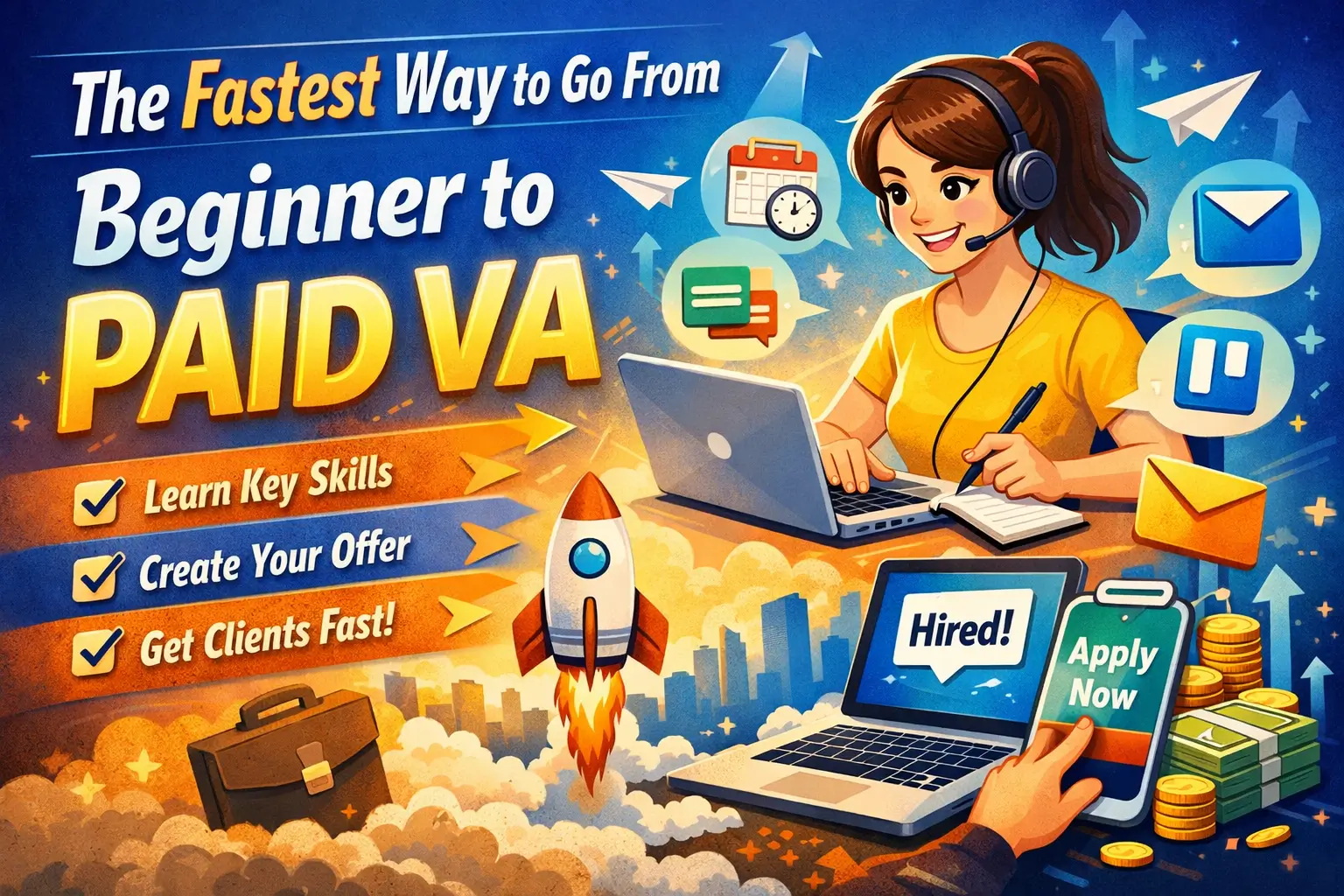
If your goal is to become a virtual assistant quickly – not someday, but within weeks – the strategy is simple:
Focus less on mastery.
Focus more on usefulness.
Because clients don’t hire “fully trained VAs.”
They hire people who can solve specific problems right now.
Let’s break down the fastest way to make that shift.
The fastest path (what actually works)

If you strip everything back, the fastest route from beginner to paid VA comes down to four steps:
- Learn a small set of in-demand admin skills
- Get comfortable with the core tools clients actually use
- Create one simple, clear service offer
- Start applying or pitching before you feel ready
That’s it.
No endless courses.
No months of preparation.
No waiting for confidence to magically appear.
This approach works because it aligns with how hiring actually happens.
Clients aren’t looking for someone who knows everything. They’re looking for someone who can take something off their plate – immediately.
When you keep your skill set narrow, your offer clear, and your focus practical, you become useful faster.
And usefulness is what gets you paid.
The goal isn’t to become an expert.
The goal is to get your first client.
Everything after that becomes easier.
Start with the right skills (not all skills)

One of the biggest time-wasters for beginners is trying to learn too much, too soon.
You don’t need advanced marketing funnels.
You don’t need complex automation systems.
You don’t need to master every VA service available.
You need the basics – the tasks that show up in most VA jobs.
The core skills to learn first
Focus on the essentials:
- Email and inbox management
- Calendar scheduling and appointment setting
- Basic admin tasks
- Data entry and light research
These are the tasks businesses constantly need help with. They’re also the easiest entry point for beginners because they’re clear, repeatable, and easy to demonstrate.
The tools clients actually use
Instead of trying to learn dozens of platforms, focus on the tools that appear again and again:
- Google Docs, Sheets, Drive, and Calendar
- Scheduling tools like Calendly or Acuity
- Project management tools such as Trello, Asana, or ClickUp
These tools form the backbone of most online businesses. If you can confidently use them, you’re already more employable than you think.
The skills that make you stand out faster
Technical ability matters but so does how you work.
Clients value:
- Clear, professional communication
- Reliability and time management
- Basic customer service skills
These are often the deciding factors when hiring a beginner VA.
Because at the end of the day, clients don’t just want tasks completed – they want peace of mind.
The key shift
The fastest learners don’t try to learn everything.
They learn what’s immediately useful, apply it quickly, and improve as they go.
That’s how you compress months of learning into weeks of progress.
Create one simple service offer

Once you have your basic skills, the next step is where many beginners get stuck.
They position themselves as:
“I can do a bit of everything.”
It sounds flexible.
But to a client, it sounds vague.
And vague doesn’t sell.
Why simplicity wins
Clients don’t hire generalists.
They hire solutions.
If someone is overwhelmed with emails, they don’t want a “virtual assistant.”
They want someone who can fix their inbox.
The clearer your offer, the faster someone can say yes.
Beginner-friendly service ideas
Start with something simple and specific, like:
- Inbox management and email organisation
- Calendar scheduling and appointment coordination
- Data entry and admin support
- Task and project organisation
These services are easy to explain, easy to trust, and easy to deliver.
How to position your offer
Instead of saying:
“I’m a virtual assistant.”
Say something like:
“I help busy founders manage their inbox, schedule meetings, and stay organised each week.”
Now it’s clear.
Now it’s valuable.
Now it’s easier to buy.
Why this speeds everything up
When your offer is simple:
- You spend less time overthinking
- Clients understand you instantly
- You can start applying sooner
And that’s the whole point.
Speed doesn’t come from doing more.
It comes from removing friction – for both you and the client.
The 30-day fast-track plan

If you stay focused and consistent, it’s entirely possible to go from beginner to paid VA within a few weeks.
Not by cramming information, but by taking targeted action.
Here’s what that can look like:
Week 1: learn the basics and pick your focus
This is your foundation phase.
- Understand what a VA actually does day-to-day
- Choose a simple service (e.g., inbox management or scheduling)
- Get comfortable with core tools like Google Docs, Sheets, and Calendar
- Explore one project management tool (Trello, Asana, or ClickUp)
Keep it tight. Don’t wander into advanced skills yet.
The goal this week isn’t mastery, it’s familiarity.
Week 2: practice and build your presence
Now you shift from learning to doing.
- Practice real-world tasks (organising inboxes, creating spreadsheets, managing calendars)
- Create a simple portfolio or service page
- Set up a professional email address
- Write a short, clear bio explaining what you offer
It doesn’t need to be perfect.
It just needs to show that you can do the work.
Week 3: start applying (before you feel ready)
This is where most people hesitate, and fall behind.
Don’t wait.
- Set up profiles on platforms like Upwork or Fiverr
- Start sending applications
- Write personalised proposals (not copy-paste)
- Focus on roles that match your simple service
Your first applications won’t be perfect. That’s normal.
The goal is to get into the market – not to get everything right immediately.
Week 4: pitch directly and build momentum
Now you expand your reach.
- Reach out to small businesses, creators, and solopreneurs
- Offer your specific service clearly
- Continue applying on freelance platforms
- Explore agencies or job boards if needed
Consistency matters more than volume.
A few strong, personalised messages will outperform dozens of generic ones.
The fastest way to get your first paid client

At this stage, it’s not about doing more – it’s about doing the right things repeatedly.
A simple, effective strategy looks like this:
- Make one clear offer
- Show that you understand the tools
- Have a basic portfolio or profile
- Apply or pitch consistently
- Personalise every message
That’s the formula.
Why personalisation changes everything
Most beginners send generic applications.
Clients can tell instantly.
When you reference their business, their needs, or a specific problem they mentioned, you stand out immediately. It shows effort. It shows attention. It builds trust.
And trust is what gets you hired, especially as a beginner.
Where to find clients fast
If speed is your priority, focus here:
- Freelance platforms like Upwork and Fiverr
- Direct outreach to small businesses and online entrepreneurs
- Content creators who need ongoing support
- Agencies and job boards (as a secondary option)
These routes work because they already contain active demand.
You’re not convincing someone to need help.
You’re offering a solution where the need already exists.
The best resources to learn quickly

You don’t need dozens of courses, just the right ones.
Focus on resources that are practical and tool-based:
- Beginner VA guides that outline real workflows
- Tutorials for Google Workspace tools
- Free structured training programs
- Customer service training for communication skills
The key is to learn just enough to apply, then learn more through real work.
The biggest mistake beginners make

It’s not a lack of skill.
It’s hesitation.
Trying to learn everything first
This leads to overwhelm, confusion, and delay.
You don’t need to know everything to start. You need to know enough to be useful.
Waiting until you feel “ready”
You won’t.
Confidence doesn’t come before action.
It comes from doing the work, making mistakes, and improving.
Every week you spend preparing instead of applying is a week you could have been earning.
The better approach
Learn → apply → adjust → improve
That’s how real progress happens.
Bringing it all together: the fast-track formula

If you want to move quickly, keep it simple:
- Learn a small set of core skills
- Focus on tools clients actually use
- Create one clear, easy-to-understand offer
- Build a basic professional presence
- Start applying early
- Improve through real experience
This is how you compress the timeline.
Not by doing more, but by doing what matters.
Conclusion: you don’t need more time – you need action

Becoming a paid virtual assistant doesn’t require months of preparation.
It requires focus.
It requires simplicity.
And most importantly, it requires action.
You don’t need to be an expert.
You need to be useful.
Because the fastest way to go from beginner to paid VA isn’t about knowing everything.
It’s about solving one problem, for one client, as soon as possible.
Everything else builds from there.
Ready to hire a Virtual Assistant?

If you’re exploring virtual assistant agencies or need guidance on which model fits your business best – now is the time to take the next step.
Let’s find the right support for your workflow, growth, and peace of mind.
The right VA doesn’t just lighten your workload – they protect your momentum.
Why start from scratch when the right team is already trained and ready to plug into your workflow?
Get Started in 3 Easy Steps:
- Book a quick discovery call
- Tell us what your business needs
- Get matched with a trained VA – in days, not weeks
Let’s Build Your Support System
📩 Click here to schedule your consultation
📞 Prefer to talk? Contact us directly at 020 4586 6800
👉 Your next VA shouldn’t just save time – they should unlock growth.
Let’s make that happen. 🚀
FAQ: The fastest way to go from beginner to paid VA
1. How long does it realistically take to get your first VA client?
For many beginners, it can take anywhere from a couple of weeks to a month – if you stay focused and take consistent action.
The biggest factor isn’t skill level. It’s how quickly you move from learning to applying. If you spend weeks preparing without putting yourself out there, it will take longer. If you start applying early, your chances increase much faster.
2. Do I need experience before applying for VA jobs?
No, but you do need proof you can do the work.
This can come from practice tasks, a simple portfolio, or examples you’ve created yourself. Clients care more about whether you can handle their tasks than whether you’ve done it before professionally.
Focus on demonstrating ability, not waiting for “official” experience.
3. What should I charge as a beginner VA?
Beginner rates vary, but the goal at the start isn’t to maximise income, it’s to gain experience and build confidence.
You can start with competitive entry-level pricing and increase your rates as you become faster, more efficient, and more specialised. Once you have systems and results, raising your prices becomes much easier.
4. What if I don’t feel confident applying yet?
That’s completely normal and also the point where most people get stuck.
Confidence doesn’t come before applying. It comes because you apply, get responses, and learn what works. Waiting until you feel ready often delays progress unnecessarily.
Start before you feel ready, and let the process build your confidence.
5. What’s the fastest way to stand out as a beginner VA?
Clarity and effort.
Have a clear, simple offer. Show that you understand the tools clients use. And most importantly, personalise your applications or outreach messages.
Most beginners send generic responses. When you take the time to tailor your message to the client’s needs, you instantly stand out – even without experience.