Introduction: the structural reality no one talks about
Business has changed.
But pressure hasn’t.
In fact, it’s intensified.
Work is faster. Tools are endless. Expectations are brutal. Every business now operates in a permanently connected ecosystem where customers expect immediacy, competitors are global, and systems multiply by the quarter.
Yet founders still have 24 hours.
Budgets still have limits.
Focus still fractures.
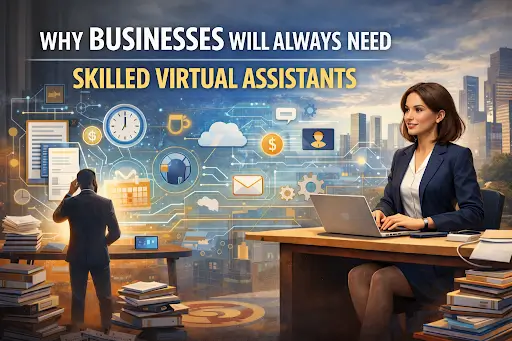
That friction – between rising complexity and finite capacity – isn’t temporary. It’s structural.
And that’s exactly why skilled virtual assistants aren’t a trend. They’re a response to how modern business actually works.
They provide expert capacity without permanent overhead.
Flexibility without fragility.
Support without bureaucracy.
As long as business remains digital, dynamic, and resource-conscious, skilled VAs won’t just be helpful.
They’ll be necessary.
Let’s start with the most fundamental truth.
1. Time and focus will always be scarce

Every leader eventually learns the same lesson:
Growth doesn’t stall because of lack of ideas.
It stalls because of lack of bandwidth.
Founders don’t spend their days crafting bold strategy. They spend them triaging inboxes, confirming appointments, responding to customer queries, fixing small operational leaks. Individually minor. Collectively suffocating.
The modern workload is relentless because business now lives across platforms:
Email.
CRMs.
Scheduling systems.
Customer service dashboards.
Social channels.
Project boards.
Internal documentation.
Each one demands attention. None of them create vision.
This is where skilled virtual assistants create leverage.
They take ownership of recurring operational tasks – not casually, not temporarily – but systematically. Inbox management becomes structured. Calendars stop colliding. Follow-ups happen on time. Data gets updated. Systems stay organized.
And suddenly, something rare returns: cognitive space.
That space is where strategy is formed.
Where partnerships are negotiated.
Where revenue moves.
Technology helps automate tasks. But automation still needs oversight, judgment, and context. Skilled VAs don’t just execute checklists, they manage ecosystems. They anticipate bottlenecks. They protect leaders from death by a thousand micro-decisions.
Time will never expand.
Focus will never multiply.
Delegation will always be essential.
That’s not a phase of business.
It’s its condition.
2. Cost pressure isn’t going away – it’s intensifying
Let’s talk about hiring.
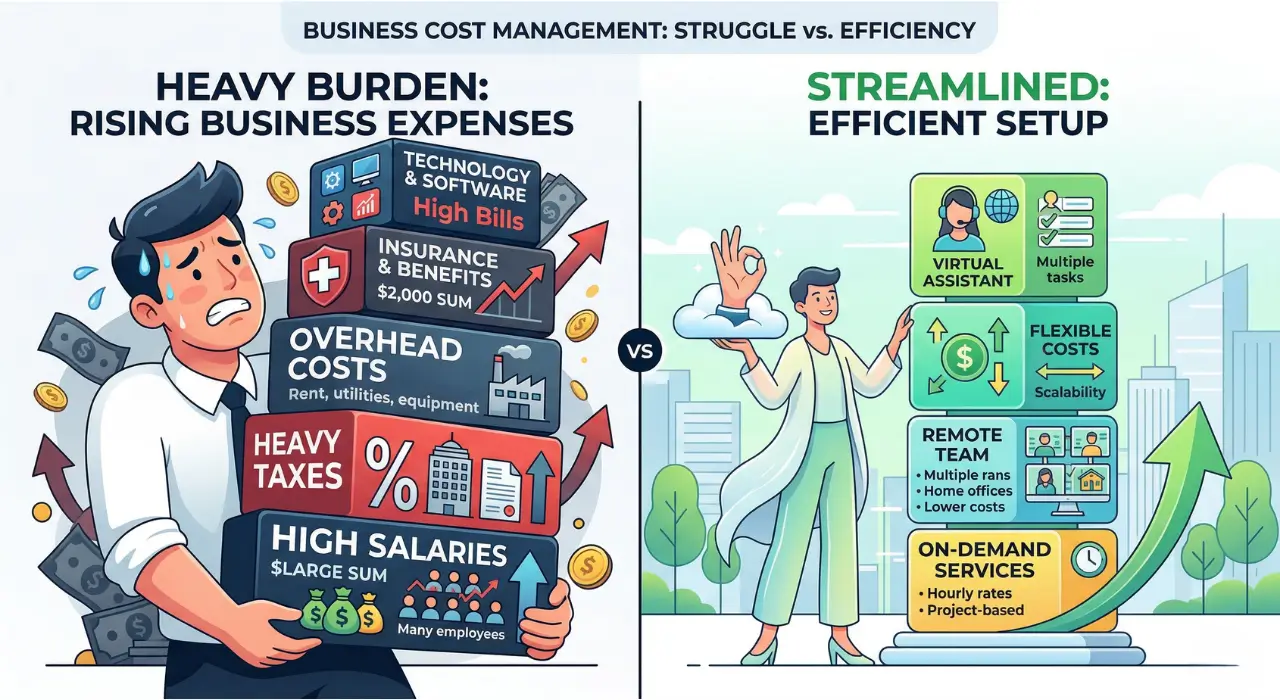
A full-time employee doesn’t cost a salary. They cost:
Benefits.
Payroll taxes.
Equipment.
Software licenses.
Onboarding time.
Long-term commitment.
Organizational complexity.
For many small and mid-sized businesses, that model is too rigid for the modern market. Demand fluctuates. Revenue ebbs and flows. Priorities shift.
But the work still needs to get done.
Skilled virtual assistants offer a structural alternative: flexible capacity without fixed overhead.
Instead of hiring for permanence, businesses can hire for precision.
Instead of paying for idle hours, they pay for output.
Instead of locking into headcount, they scale support up or down based on real demand.
This isn’t about cutting corners. It’s about intelligent resource allocation.
Lean operations are no longer a startup philosophy – they’re survival strategy. Companies that carry unnecessary fixed costs become brittle. Companies that build flexible support structures stay adaptive.
Virtual assistants create that adaptability.
They allow businesses to stay financially agile without sacrificing execution. They protect margins without shrinking ambition.
And in an economy that rewards efficiency and punishes excess, that model isn’t temporary.
It’s sustainable.
3. Modern businesses are too complex for one skillset

There was a time when a business needed three things: a product, a phone line, and a ledger.
That time is gone.
Today, even small companies rely on:
CRM systems
Email marketing automation
Content pipelines
Social media management
Customer onboarding workflows
Data tracking dashboards
Project management platforms
Payment processors
Tech integrations
Each of these tools requires maintenance. Optimization. Understanding.
Hiring a full-time specialist for each function? Unrealistic.
Ignoring them? Dangerous.
This is where skilled VAs shift from “helpful” to “strategic.”
The modern virtual assistant is often a trained professional: experienced in digital marketing, operations management, bookkeeping software, automation tools, and niche platforms. Many bring certifications. Many bring cross-industry insight from supporting multiple businesses.
That cross-pollination of knowledge is powerful.
It means your systems don’t just get managed, they get improved.
Your workflows don’t just continue, they get refined.
Your tools don’t just exist, they get leveraged properly.
And because talent is no longer geographically limited, businesses can access niche expertise that might not exist locally.
Need someone who understands podcast production workflows?
Sales funnel tech?
Multilingual customer support?
You’re no longer constrained by your zip code.
As business complexity increases – and it will – the demand for skilled, specialized, flexible support will increase with it.
Because no founder can master every platform.
No small team can cover every discipline.
And no company can afford inefficiency at scale.
4. Remote and digital work are the default setting now

The office didn’t disappear.
It dissolved.
Work now happens in shared drives, Slack threads, CRMs, dashboards, and inboxes. Teams collaborate across time zones without blinking. Customers buy, complain, subscribe, cancel, and review – all online.
This isn’t a temporary shift. It’s an operating system upgrade.
And virtual assistants are native to it.
Skilled VAs are fluent in the architecture of modern business:
- Cloud-based project management
- Digital communication platforms
- Email marketing systems
- Automation tools
- Online customer service workflows
- CRM databases
They don’t need cubicles. They need clarity.
They don’t require proximity. They require process.
As more operations migrate into digital ecosystems, businesses need professionals who can manage those systems with precision. Someone must oversee automations. Someone must maintain order. Someone must ensure that leads don’t vanish into the void.
Technology creates infrastructure.
Skilled people keep it functional.
Virtual assistants aren’t an adaptation to digital work, they’re a natural extension of it.
As long as business remains online (and it will), there will be a place for professionals who can operate fluently within that environment.
5. Scalability is no longer optional

Business demand doesn’t move in straight lines.
It spikes.
It plateaus.
It surges during launches.
It slows during transitions.
Traditional hiring struggles with that unpredictability. Bringing on full-time staff for temporary growth is risky. Waiting too long to hire during expansion is dangerous.
Skilled virtual assistants create elasticity.
Need extra support during a product launch? Increase hours.
Entering a quieter quarter? Reduce engagement.
Testing a new initiative? Bring in specialized help temporarily.
That flexibility transforms fixed costs into variable ones — a subtle but powerful shift.
It lowers risk.
It accelerates responsiveness.
It allows growth without overextension.
For startups and small businesses especially, scalability isn’t a luxury. It’s survival. Opportunities appear quickly. Market conditions shift fast. Companies that can expand operational capacity without restructuring their entire payroll win.
Virtual assistants make that possible.
They allow businesses to grow deliberately – not recklessly.
And because volatility isn’t going away, neither is the need for scalable support.
6. Customer expectations are rising – relentlessly

Customers no longer tolerate silence.
They expect rapid replies.
Clear communication.
Seamless onboarding.
Consistent follow-up.
And they expect it across multiple channels.
A single missed email can cost revenue. A delayed response can damage reputation. Disorganized systems can quietly erode trust.
But here’s the tension: delivering high-touch service requires time. And leadership time is already stretched.
Skilled virtual assistants bridge that gap.
They monitor inboxes.
They manage inquiries.
They maintain structured follow-up systems.
They ensure that leads are tracked and clients feel supported.
In some cases, they extend coverage across time zones, meaning the business remains responsive even when leadership is offline.
This does more than protect revenue. It protects energy.
When owners aren’t constantly reacting to operational fires, they lead better. When systems run smoothly, customer experiences improve. When communication is consistent, trust compounds.
As expectations continue to rise, and they will, businesses will require structured support behind the scenes.
The alternative is burnout or inconsistency.
Neither scales well.
7. Skilled VAs are strategic assets – not cheap labour

There’s a difference between outsourcing tasks and building operational leverage.
Cheap help executes instructions.
Skilled virtual assistants think.
They notice inefficiencies.
They suggest better tools.
They refine workflows.
They improve systems quietly and consistently.
Over time, a high-quality VA doesn’t just complete tasks: they become embedded in operations. They understand context. They anticipate needs. They act with informed judgment.
That kind of partnership cannot be replicated by one-off freelancers or basic automation.
Case after case shows the same pattern: when founders bring in skilled support, revenue grows while workload decreases. Not because someone is “doing admin,” but because operations become smoother, more intentional, more optimized.
This is where the distinction matters.
Businesses will always need assistance.
But businesses that invest in skilled assistance gain something far more valuable than task completion.
They gain operational intelligence.
And in a competitive market, that edge compounds.
Bringing it all together
Let’s zoom out.
Time will always be limited.
Costs will always matter.
Business complexity will keep increasing.
Digital systems will continue evolving.
Demand will remain unpredictable.
Customer expectations will rise.
None of these forces are temporary.
Skilled virtual assistants sit at the intersection of all of them.
They free leadership time.
They protect margins.
They bring specialized expertise.
They enable scalable growth.
They strengthen customer experience.
They improve systems, not just manage them.
That’s not trend-based relevance.
That’s structural necessity.
As long as businesses must balance ambition with limitation – growth with constraint – they will need flexible, intelligent, digital-first support.
They will need skilled virtual assistants.
Conclusion: the real question
The question isn’t whether businesses will need VAs.
The real question is this:
How long can a business afford to operate without one?
If your time is fragmented…
If your systems feel heavier than they should…
If growth is happening, but at the cost of energy…
It may not be a hiring decision.
It may be a structural upgrade.
And the businesses that recognize that early won’t just survive modern complexity.
They’ll thrive inside it. ✨
Ready to hire a Virtual Assistant?
If you’re exploring virtual assistant agencies or need guidance on which model fits your business best – now is the time to take the next step.
Let’s find the right support for your workflow, growth, and peace of mind.
The right VA doesn’t just lighten your workload – they protect your momentum.
Why start from scratch when the right team is already trained and ready to plug into your workflow?
Get Started in 3 Easy Steps:
- Book a quick discovery call
- Tell us what your business needs
- Get matched with a trained VA – in days, not weeks
Let’s Build Your Support System
📩 Click here to schedule your consultation
📞 Prefer to talk? Contact us directly at 020 4586 6800
👉 Your next VA shouldn’t just save time – they should unlock growth.
Let’s make that happen. 🚀
FAQ: Why businesses will always need skilled virtual assistants
1. Are virtual assistants only for small businesses or startups?
Not at all.
While startups and small businesses often feel the impact first, companies of all sizes use skilled virtual assistants to increase efficiency. Growing agencies, established firms, and even executive teams rely on VAs to manage operations, streamline communication, and support specialized projects.
The need isn’t about size.
It’s about capacity.
Any business facing time constraints, rising complexity, or scaling pressure can benefit from flexible expert support.
2. What’s the difference between a skilled virtual assistant and a general freelancer?
A general freelancer typically completes isolated tasks.
A skilled virtual assistant integrates into your operations.
They understand your systems, workflows, and priorities. They manage ongoing responsibilities, anticipate needs, and improve processes over time. Instead of working transactionally, they operate relationally as a long-term operational partner.
The difference isn’t just output.
It’s ownership.
3. Can’t automation or AI replace a virtual assistant?
Automation is powerful, but it requires oversight.
Tools can schedule emails, trigger workflows, and organize data. But they cannot exercise judgment, adapt to nuance, or troubleshoot unexpected issues without human direction.
Skilled VAs often manage and optimize automation tools. They ensure systems run smoothly and step in when processes need refinement.
Technology handles repetition.
Professionals handle complexity.
The two work best together – not in competition.
4. How do businesses know when it’s time to hire a virtual assistant?
There are clear signals:
- You’re spending too much time on administrative or repetitive tasks.
- Follow-ups are slipping through the cracks.
- Growth feels chaotic instead of structured.
- You’re delaying strategic work because operations consume your day.
- Revenue is increasing, but so is overwhelm.
If delegation would immediately free 5–10 hours a week, it’s likely time.
Hiring a skilled VA isn’t about “getting help.”
It’s about reclaiming focus.
5. Is hiring a virtual assistant cost-effective long term?
When approached strategically, yes.
Skilled VAs reduce the need for premature full-time hires, protect leadership time (which directly impacts revenue), and improve operational efficiency. The return isn’t just financial savings: it’s better systems, faster responsiveness, and sustainable growth.
In many cases, the cost of not hiring support shows up as missed opportunities, slower execution, or burnout.
The real investment isn’t in assistance.
It’s in operational strength.